Life in a Honda Hybrid Model in Quebec: Real Savings at the Pump
June 22 2026,
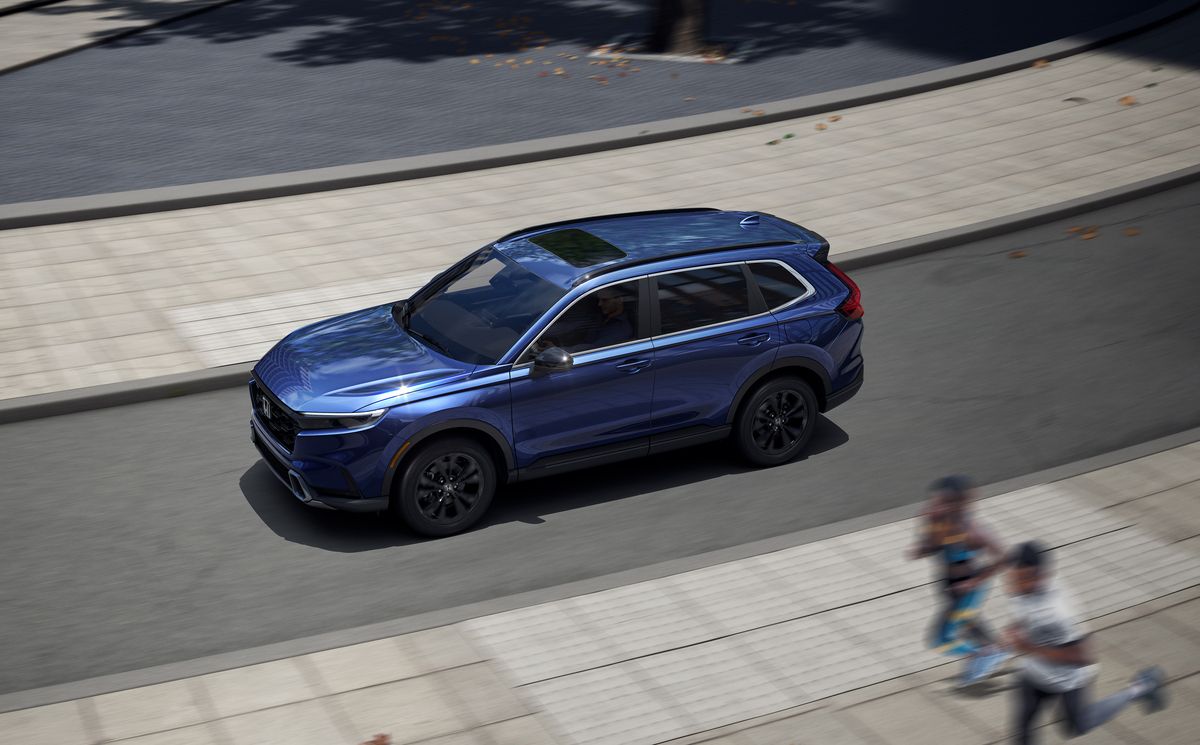
For the past few years, the question has no longer been whether hybrid technology is reliable or if it provides driving pleasure. The technology has matured. The fuel economy figures are there to prove it, as is the reliability. And hybrid CR-V or hybrid Civic owners in Montreal will tell you: their experience is resolutely positive.
The real question is whether the extra cost at purchase is justified by the subsequent savings at the pump, and how much time will be needed to recoup the difference.
At Honda, the hybrid lineup relies on a single core system: the fourth-generation two-motor hybrid powertrain. It powers the CR-V, Accord, and Civic, with a few variations depending on the model. It is a proven architecture, having gathered data over several million kilometers in Canada and the United States.
The CR-V Hybrid: The best argument in figures
The 2026 CR-V Hybrid relies on a 2.0-liter 4-cylinder engine paired with the two-motor electric system, delivering a combined 204 horsepower and 247 pound-feet of instantly available torque. In all-wheel drive, the combined fuel economy is 6.4 L/100 km (Sport Hybrid, EX-L Hybrid, and Touring Hybrid trims).
The gas-powered CR-V with all-wheel drive consumes 8.4 L/100 km combined. Based on 20,000 km driven per year and fuel priced at $1.75 per liter, the difference represents about $560 in annual savings at the pump from the fuel economy gap alone between the two powertrains. The payback horizon depends on the price gap between the two versions, but this data provides a concrete order of magnitude.
During winter in Montreal, Honda hybrids generally display slightly higher fuel consumption than in the summer, just like all vehicles. The high-voltage battery loses some of its capacity in extreme cold, and the electric heating demands more energy. That said, regenerative braking remains active even below freezing, and the integrated Snow mode found in all 2026 CR-Vs also applies to the hybrid version.
The savings are therefore still present in winter, because the gas model will also consume more.
The Civic Hybrid: The compact that changes habits

The 2026 Civic Hybrid is available in sedan and hatchback configurations, in the Sport Hybrid and Sport Touring Hybrid trims. The two-motor electric system, coupled with the 2.0-liter 4-cylinder engine, produces 200 horsepower and 232 pound-feet of torque. The city fuel economy for the Sport Hybrid sedan stands at 4.7 L/100 km, according to Canadian government data.
Based on 15,000 km driven per year with 70% of that in the city, and comparing the Civic Sport Hybrid (4.9 L/100 km combined) to a standard version that consumes about 7.0 L/100 km under the same conditions, the gap represents about $545 in annual savings at $1.75 per liter. And the drive is no less enjoyable: Honda’s hybrid system operates seamlessly, power is immediately available, and the electronically controlled continuously variable transmission (eCVT) is significantly smoother than a conventional CVT.
What the Honda hybrid system does differently
Honda’s two-motor system operates differently from a conventional parallel hybrid. In most urban driving situations, the combustion engine acts primarily as a generator, while the electric motors propel the vehicle. The gas engine takes over direct drive to the wheels mainly at stable highway speeds, optimizing consumption in the speed range where the internal combustion engine is most efficient.
This operation makes the system particularly well-suited for the typical urban and semi-urban driving of Montreal: frequent stops at traffic lights, traffic jams on the Metropolitan Expressway or Highway 40, and commuting through high-density neighborhoods. It is precisely under these conditions that the advantage of a hybrid powertrain is most pronounced.
Honda's hybrid powertrain received the Wards 10 Best Engines and Propulsion Systems award for two consecutive years, a well-deserved technical recognition.
A Honda hybrid or all-electric vehicle: A question of priorities
Honda’s hybrid models do not require a home charging station. The vehicle recharges itself while driving, thanks to energy recovery during braking and the combustion engine. This is a concrete advantage for Montreal residents living in apartments or condos without access to a dedicated outlet, or for those who regularly make long trips outside the city.
To discover the Honda CR-V Hybrid or the Honda Civic Hybrid, or to ask our specialists your questions about real-world fuel economy during a Montreal winter, feel free to book an appointment with a member of our team. They will be delighted to guide you through your buying process, starting with a test drive tailored to your driving habits.