Ranking of 2026 Honda Models by City Fuel Efficiency
January 20 2026,
Finding yourself stuck in heavy traffic on the Décarie Expressway at rush hour has an impact on your budget. The Montreal reality of stop-and-go, construction zones, traffic jams approaching the Champlain Bridge, and slow downtown traffic demands the choice of vehicles equipped with powertrains optimized for urban driving.
The 2026 Honda hybrid range responds exactly to these needs, with three models employing variations of the two-motor hybrid system specifically designed for city efficiency.
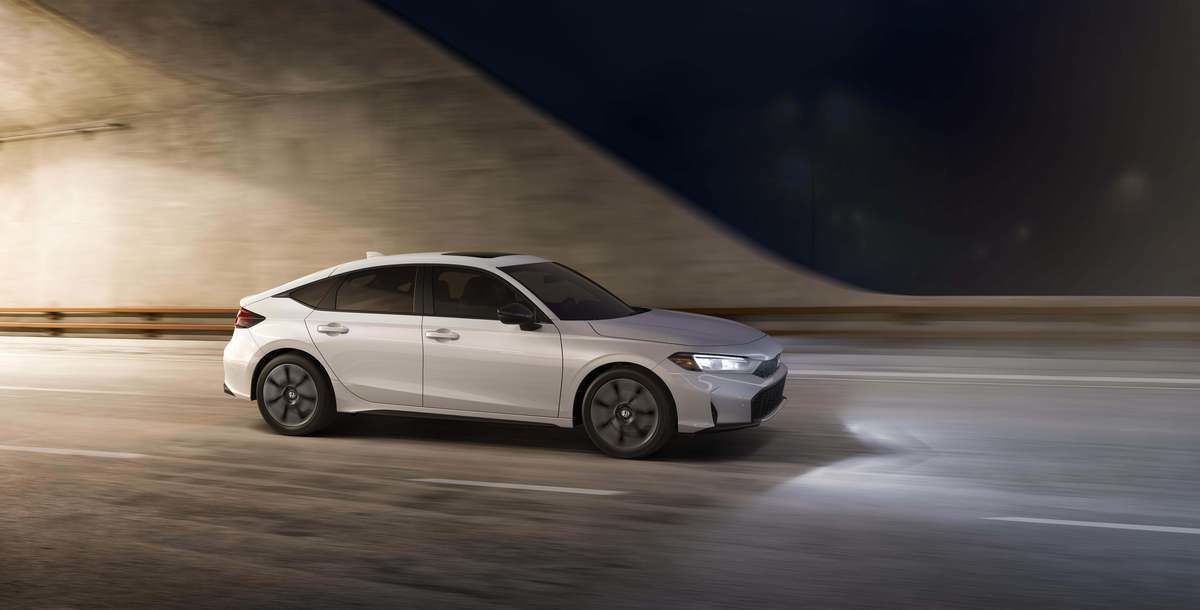
The Champion: Civic Hybrid at 4.7 L/100 km City
The Civic Hybrid dominates urban efficiency with a remarkable rating of 4.7 L/100 km in the city. This figure is not marketing hyperbole; it reflects the sophistication of Honda's fourth-generation two-motor system applied to a compact sedan. The 2.0-litre, 4-cylinder Atkinson-cycle engine combines with twin electric motors generating a combined 200 horsepower and 232 pound-feet of torque.
This torque figure matters immensely in Montreal contexts. Electric motors deliver maximum torque instantly from 0 rpm, transforming starts at traffic lights and highway merges. The Civic Hybrid accelerates briskly during restarts and when merging onto Highway 20.
The system's intelligence shines during downtown driving. When idling through Plateau construction sites at 15 km/h, the Civic operates primarily in electric mode, with the gasoline engine dormant. Regenerative braking captures energy during the endless stops characterizing Park Avenue, storing it in the lithium-ion battery for subsequent acceleration. This constant cycling between electric and hybrid modes produces the exceptional rating found in the city.
For Montreal buyers, it is important to correctly calculate annual savings. Someone driving 15,000 km with 70% city driving—typical for downtown residents—consumes approximately 493 litres annually with the Civic Hybrid. A comparable non-hybrid version, consuming 7.5 L/100 km in the city, would burn approximately 788 litres. With fuel prices around $1.65/litre, that is nearly $485 saved annually just on fuel.
Second: Accord Hybrid at 5.0 L/100 km City

The Accord Hybrid employs a two-motor hybrid architecture identical to that of the Civic, but adapted to the larger intermediate platform. City consumption reaches 5.0 L/100 km, which is slightly higher than the Civic due to increased mass and dimensions, but still exceptional for a sedan offering true rear-seat space and impressive trunk volume.
The 204 combined horsepower matches the Civic Hybrid's performance, although the Accord's additional 80 kg and larger dimensions create marginally more work for the powertrain. This slight efficiency penalty buys you significantly more interior volume, which is crucial if your typical Montreal use includes transporting clients, carrying equipment, or weekend trips to the Vermont ski hills with passengers and luggage.
The Accord’s urban behavior reproduces the Civic’s intelligent power management. Slow movement across the cobblestones of Old Montreal is done purely on electric power. Acceleration from the lights on René-Lévesque engages both engines seamlessly. Highway cruising at 100 km/h sees the gasoline engine drive the wheels directly while the battery maintains its charge. In fact, Honda's system constantly changes modes according to the optimal efficiency it calculates.
For professionals who need an intermediate sedan but do not wish to be penalized at the pump, the Accord Hybrid delivers the goods. Here too, depending on the number of kilometers driven annually, the fuel savings are substantial.
The Versatile Option: CR-V Hybrid Fuel Economy Varies by Version
The CR-V Hybrid offers different consumption averages depending on the version. The Sport Hybrid, EX-L Hybrid, and TrailSport Hybrid trims share the same powertrain but differ in weight, do not wear the same wheels, and feature small aerodynamic details that play a role at the pump.
What is certain is that the CR-V Hybrid employs the same fundamental two-motor architecture as the Civic and Accord. It is, of course, adapted to the SUV platform, which is larger and offers all-wheel drive as standard. Despite this, the system allows for electric-only driving at low speeds, smooth hybrid operation during acceleration, and efficient highway cruising. Montreal buyers gain the SUV's high driving position and cargo versatility without catastrophic fuel consumption.
The CR-V's urban advantage appears most clearly during winter. The standard all-wheel drive handles January snow without drama, while the hybrid powertrain maintains efficiency even when heating the cabin. Traditional SUVs with conventional powertrains and AWD often see their consumption climb to 12–14 L/100 km in the city during cold weather driving. The CR-V Hybrid consumes about half that, at 6.4 litres per 100 km.
Summary
For pure urban efficiency in Montreal, the Civic Hybrid wins mathematically at 4.7 L/100 km city. The Accord Hybrid follows closely at 5.0 L/100 km while offering significantly more space and presence. The CR-V Hybrid trades slightly higher consumption for SUV versatility and standard all-wheel drive.
The comparison between these hybrid solutions is interesting. They deliver exceptional urban efficiency. Perhaps the real comparison to make is against non-hybrid models. Someone choosing a Civic Hybrid over another non-hybrid compact car saves approximately $485 annually in fuel alone, assuming typical Montreal driving patterns. Over a five-year ownership period, that is $2,425 in fuel savings, which is not to be overlooked.
At Lallier Honda Montréal, we invite you to come and experience how these hybrid systems actually behave in Montreal traffic. You will quickly see that the efficiency is truly there.